

Sedentary Work. Modern life has performed a magic trick: it has convinced us that being “productive” requires being motionless.
For the vast majority of professionals, the day is spent transitioning from a bed to a car seat, then to an office chair, back to a car seat, and finally to a sofa.
We have become an “upholstered” species.
While we might feel like we are working hard, our bodies are essentially entering a state of physiological hibernation. This isn’t just about “not exercising” it is a distinct biological state that active research identifies as a primary threat to human health.
Scientists studying the link between behavior and chronic diseases have long warned about the dangers of a sedentary lifestyle. Now, with fresh data in hand, the urgency is higher than ever.
Sedentary Work and The good news?
The antidote isn’t a grueling marathon; it’s far simpler than you might think.
How Much Do We Actually Sit?
If you ask the average adult how much time they spend sitting, they will likely estimate around six hours. It sounds reasonable a workday plus a bit of TV time. However, when researchers stop relying on surveys and start using technology, the reality is startling.
By utilizing accelerometers devices that measure actual movement and tilt researchers found that the real figure is closer to 10 hours a day. This discrepancy exists because we don’t count the “micro-sitting” moments.
The 15 minutes checking emails in the morning, the 45-minute commute, the lunch break, and the evening “scroll” on social media.
Global Risk Factors by the Numbers.
The World Health Organization (WHO) has categorized physical inactivity as the fourth leading risk factor for global mortality. To put that in perspective, it sits alongside high blood pressure and tobacco use as a primary driver of preventable death.
Statistic Impact/Value.
WHO Recommended Activity 150 min (moderate) or 75 min (vigorous) / week. Global Compliance Only 73% of adults meet these minimums.
The “10% Goal” Increasing global activity by 10% could prevent ~500 million deaths. Daily Average Sitting ~10 hours (measured by accelerometers)
The Biological “Engine” on Idle.
What Happens Inside?
From a biological standpoint, sitting is not merely the “absence of movement.” It is a proactive physiological state that triggers a cascade of negative effects.
Think of your body like a high-performance car engine. When you sit, you aren’t just parked; you are idling at a red light for ten hours straight.
1. The Death of the LPL Enzyme.
One of the most critical discoveries in sedentary research involves an enzyme called Lipoprotein Lipase (LPL). This enzyme is the primary “vacuum cleaner” of the bloodstream. Its job is to capture fats (triglycerides) floating in the blood and deliver them to muscles and organs to be burned as fuel.
When you remain seated for prolonged periods:
• Muscle contractions in the legs the largest muscle groups in the body—essentially cease.
• The production of LPL plummets.
• Fat remains in the bloodstream longer, leading to arterial plaque and metabolic dysfunction.
In animal studies, LPL levels dropped significantly within hours of inactivity. For humans, this means that even if you are “thin,” your internal chemistry could resemble that of someone with clinical obesity.
2. Insulin Resistance and Glucose Management.
Muscles are the primary consumers of blood sugar (glucose). When muscles are inactive, they become less sensitive to insulin. This means your pancreas has to pump out more insulin to get the same job done.
Over months and years, this “overwork” of the metabolic system significantly increases the risk of Type 2 Diabetes.
3. The Vascular and Structural Toll.
The human circulatory system is designed to work against gravity, aided by the “muscle pump” of our calves.
When we sit:
• Blood Pooling: Blood settles in the lower extremities, increasing the risk of varicose veins and, more dangerously, Deep Vein Thrombosis (DVT).
• Postural Collapse: The “Text Neck” or “Computer Slump” becomes a permanent structural change. The hip flexors shorten, the glutes (the body’s powerhouse) “turn off,” and the spine loses its natural curvature.
• Cognitive Decline: Long-term sedentary behavior is now being linked to an increased risk of dementia and depression, likely due to reduced blood flow to the brain and lower levels of brain-derived neurotrophic factor (BDNF).
Can the Gym Save You?
This is the question every office worker asks: “If I go to the gym for an hour after work, am I safe?” The answer is a nuanced “yes and no.”
A massive study published in JAMA Cardiology, involving over 105,000 participants across 21 countries, led by Professor Scott Lear, provided a definitive look at this.
The researchers found that prolonged sitting is linked to a higher risk of premature death regardless of physical activity levels.
However, the risk is a spectrum:
1. The High-Risk Group: Those who sit 8+ hours and do not exercise.
2. The “Active Couch Potato”: Those who meet WHO guidelines (150 mins/week) but still sit 10 hours a day. Their risk is lower than the first group, but still significantly higher than someone who sits less.
3. The Buffer Effect: Regular exercise acts as a “buffer,” but it doesn’t completely “delete” the damage done during the day.
Key Takeaway: You cannot “out-run” a sedentary job with a single hour of exercise if the remaining 23 hours are spent motionless. Health is a cumulative result of how you move throughout the entire day.

The Standing Desk Myth.
Why Standing Isn’t the Cure.
The standing desk industry has exploded, marketed as the “cure-all” for office health. Unfortunately, the science suggests we might be overvaluing them.
Research shows that prolonged standing affects the metabolism in almost the same way as sitting. If you are standing still, your muscles aren’t contracting dynamically, and the LPL enzyme remains sluggish. Furthermore, standing in one place for eight hours introduces new problems:
• Increased pressure on the lower back.
• Higher risk of varicose veins due to static loading.
• Muscle fatigue that can lead to poor posture.
The solution isn’t to swap sitting for standing; it’s to swap stillness for movement.
The “2-Minute Rule”.
A Practical Strategy for the Busy Professional.
Since we can’t all quit our desk jobs to become park rangers, we need a strategy that fits into a corporate schedule. Professor Scott Lear suggests a incredibly simple but effective tactic: Break the sedentary cycle every 20–30 minutes with just two minutes of movement.
Why two minutes?
Because that is the “re-ignition” time required to jumpstart your metabolic processes. It’s enough to tell your body, “Hey, we are still active! Keep the enzymes flowing!”
How to Implement the 2-Minute Protocol. You don’t need a gym kit or a shower. Any activity that gets your blood pumping will work:
• The Office Loop: A brisk walk to the water cooler and back.
• Desk Squats: 15–20 air squats next to your chair.
• Stair Climb: One flight up and one flight down.
• Standing Meetings: Take your calls while pacing the room.
• Calf Raises: Do 30 calf raises while reading a long email.
The Impact of Tiny Changes.
According to the JAMA Cardiology data, replacing just 30 minutes of sitting with movement throughout the day reduced the risk of premature death by approximately 2% for those who sit more than four hours.
While 2% might sound like a small number, on a global population scale, that represents hundreds of thousands of lives saved. For you, it represents a significant increase in “healthspan”the portion of your life spent in good health.
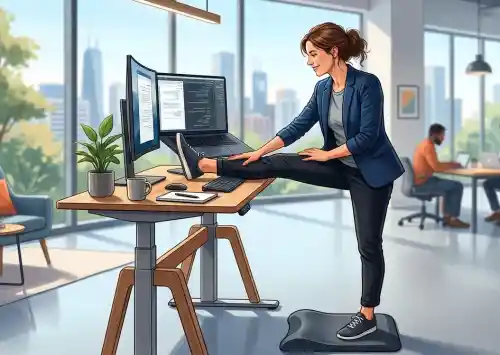
Simple Habits for a More Active Workday.
Integrating movement doesn’t require radical lifestyle changes. It requires environmental triggers.
1. The Timer Method: Set a recurring timer on your phone or computer for 25 minutes. When it dings, you must stand up for 120 seconds.
2. Drink More Water: This creates a natural “forced” movement break—you have to get up to refill your glass, and you have to get up to use the restroom.
3. The “Phone Pace”: Make it a rule that you never take a phone call while sitting. If the phone rings, you stand up.
4. Peripheral Printers: If possible, use a printer that is further away from your desk to encourage extra steps.
Movement as Basic Hygiene.
The core message from modern health science is clear: Movement is not a hobby; it is a biological necessity. We shouldn’t view these two-minute breaks as “fitness.”
Instead, think of them as “biological hygiene,” much like brushing your teeth. You wouldn’t skip brushing your teeth for a week and then try to “fix it” by brushing for five hours on Saturday.
Similarly, you shouldn’t remain motionless all week and expect a Sunday hike to fix the metabolic damage.
By reclaiming just two minutes every half hour, you aren’t just protecting your heart and your waistline you are preserving your mobility, your cognitive function, and your future. Your body was built to move; it’s time to let it do its job.
Have a Great Day!
