
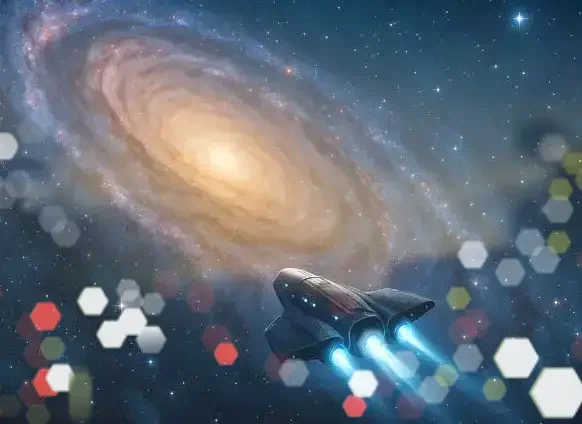
Galaxy Eternity. To fly to another galaxy. The very thought ignites the imagination. It sounds like the opening chapter of the most thrilling saga in human history.
To leave behind everything we know and venture into the truly unknown. What wonders might await us in the cosmic dark? Planets orbiting twin suns, casting dual shadows across alien landscapes.
Stars of impossible shapes and colors. Oceans of liquid methane churning under a thick, hazy atmosphere. Perhaps, even forms of life so fundamentally different from our own that we can barely conceive of their existence.
Every discovery would be revolutionary, and the familiar laws of physics that govern our world might bend and twist into new, unrecognizable forms.
For now, however, this epic journey remains firmly in the realm of dreams and science fiction. The ambition to touch the stars of another galaxy is a testament to our insatiable curiosity, but the universe itself presents a series of colossal barriers.
It’s not just one obstacle, but a fortress of challenges built from the very fabric of spacetime, technology, and our own biological fragility. Let’s explore the seven fundamental reasons why humanity is, for the foreseeable future, confined to our home galaxy, the Milky Way.
Galaxy Eternity, Tyranny of Unfathomable Distance.
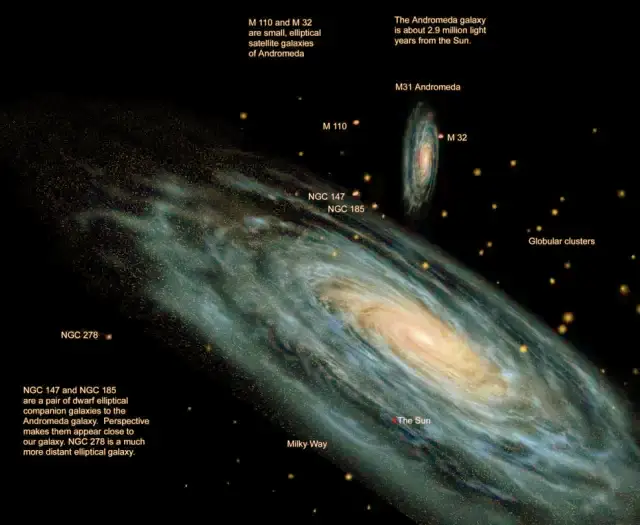
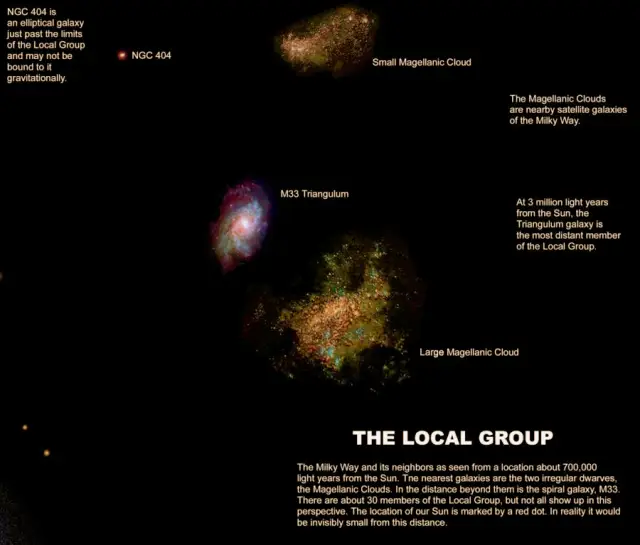
The first and most daunting barrier is distance a distance so vast it renders our human measurements almost meaningless. Our closest major galactic neighbor is the Andromeda Galaxy.
It’s a breathtakingly beautiful spiral, a cosmic sibling to our own Milky Way, and it’s practically on our cosmic doorstep. Yet, this “close” neighbor is approximately 2.5 million light-years away.
Let’s try to put that number into perspective. A light-year is the distance light travels in one year, which is about 9.46 trillion kilometers (or 5.88 trillion miles).
So, the light from Andromeda that we see tonight began its journey 2.5 million years ago. At that time, modern humans hadn’t even evolved yet. Our early ancestors, like Homo habilis, were just beginning to walk the Earth.
A message sent to Andromeda at the speed of light today would only arrive when our planet is 2.5 million years into the future.
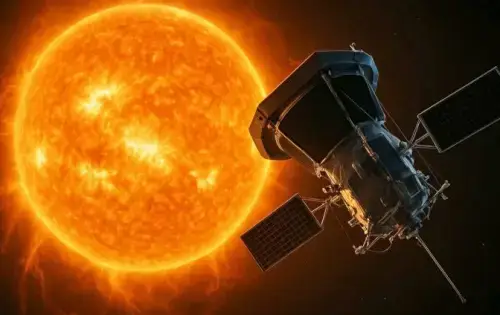
Now, consider our fastest spacecraft, the Parker Solar Probe. Using gravitational assists from the Sun, it has reached incredible speeds of about 692,000 km/h (430,000 mph). While impressive, this is only about 0.064% of the speed of light.
If we aimed the Parker Solar Probe at Andromeda, the journey wouldn’t take 2.5 million years; it would take approximately 3.9 billion years. That’s nearly the age of the Earth itself and long enough for our own Sun to have exhausted its fuel and died.
And Andromeda is just the closest one!!!
The countless other galaxies we can observe are tens of millions, hundreds of millions, or even billions of light-years away. The sheer scale of the universe is the first, and perhaps the greatest, wall we face.
The Universal Speed Limit.
“Why not just build a faster ship?” one might ask. The problem isn’t just an engineering challenge; it’s a fundamental law of the cosmos. According to Albert Einstein’s theory of special relativity, nothing with mass can ever reach the speed of light.
The reason lies in the famous equation, E=mc2, which establishes a profound link between mass and energy. As an object accelerates, its kinetic energy increases.
However, as it gets closer and closer to the speed of light, something strange happens: its relativistic mass increases. More and more of the energy being pumped into the object to accelerate it is converted into mass instead of speed.
To reach the speed of light, an object’s mass would become infinite, and consequently, it would require an infinite amount of energy to move it. The universe has a strict speed limit, and it’s enforced not by cosmic police, but by the very nature of energy and matter.
This isn’t a technological hurdle we can overcome with a better engine; it’s a core principle of physics.
Our Technological Infancy.
Even if we aimed for a tiny fraction of light speed, our current technology is nowhere near what’s required. The engines that powered our journeys to the Moon and sent probes to the outer planets are chemical rockets.
They work by creating a controlled explosion and directing the force in one direction. This method is incredibly powerful for short bursts but woefully inefficient for long-duration space travel due to the enormous amount of fuel required.
Scientists are exploring more advanced propulsion concepts. Ion drives, which use electric fields to accelerate charged particles, are far more efficient but produce very low thrust.
Solar sails could harness the faint pressure of starlight to build up speed over decades. More radical ideas include nuclear propulsion, such as Project Orion, a Cold War-era concept to detonate nuclear bombs behind a spacecraft to propel it forward.
While powerful, even these theoretical engines would be painfully slow for an intergalactic voyage. They might make interstellar travel within our own galaxy feasible over centuries or millennia, but they barely make a dent in the journey to Andromeda.
The Crushing Weight of Logistics.
An intergalactic voyage is not just a trip; it’s the relocation of a civilization. The ship would need to be a completely self-sufficient world, a “generation ship,” carrying everything needed for millions of years.
• Energy and Fuel:
The amount of fuel needed for such a journey is staggering. The rocket equation shows that for a ship to reach high speeds, the vast majority of its initial mass must be fuel, leaving little room for the actual payload, crew, and habitat.
The ship would need a revolutionary power source, perhaps matter-antimatter annihilation or harnessing energy from black holes, concepts that are purely theoretical today.
• Life Support:
The crew would need a perfectly closed-loop ecosystem. Every drop of water, every molecule of oxygen, and every nutrient would have to be recycled with 100% efficiency for thousands upon thousands of generations.
The International Space Station has advanced life support, but it’s not perfectly efficient and requires regular resupply missions from Earth.
• Food and Resources:
The crew couldn’t pack millions of years’ worth of food. They would need to grow it, meaning a massive, stable, and diverse agricultural system would be required.
Furthermore, the ship itself would degrade. Every component, from computer chips to hull plates, would eventually fail. The ship would need advanced manufacturing facilities, 3D printers, and a vast reserve of raw materials to fabricate any conceivable spare part for millions of years.
The Constraints of a Human Lifetime.
Even if we could solve all the technological problems, the human element remains a profound challenge.
At a hypothetical 10% of the speed of light (a speed far beyond our wildest dreams), the trip to Andromeda would still take 25 million years. This journey would span over one million human generations.
Imagine a society confined to a starship for its entire existence. The generation that arrives at Andromeda would be unimaginably distant from the ancestors who started the voyage.
Would they still remember the mission’s purpose?
Would they even care about a planet called “Earth” that they had never seen? Maintaining social cohesion, purpose, and sanity within a closed environment for millions of years is a sociological and psychological problem of immense proportions.
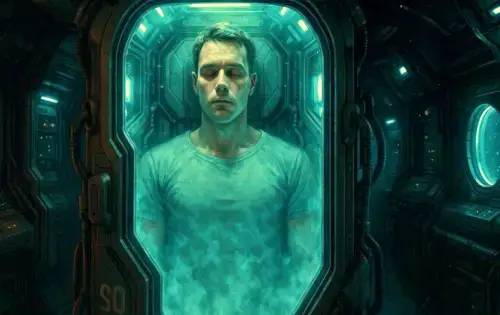
Concepts like cryogenic suspension (freezing the crew) are popular in fiction, but we currently have no idea how to safely freeze and reanimate a human being without causing irreversible cellular damage.
The Endless Dangers of the Void.
Intergalactic space is not empty. It’s an incredibly hostile environment, filled with perils that a ship would have to endure for eons.
• Radiation:
Outside the protective bubble of Earth’s atmosphere and magnetic field, space is flooded with lethal radiation. Galactic Cosmic Rays (GCRs) are high-energy particles from distant supernovae that can slice through DNA and destroy electronics.
A ship would require immensely thick and heavy shielding, which, again, adds to the mass and fuel problem.
• Micrometeoroids:
The void is filled with tiny dust particles and rocks. While seemingly harmless, when you collide with one at a significant fraction of the speed of light, the kinetic energy released is explosive.
A single grain of sand could impact with the force of a bomb, potentially causing catastrophic damage. Over millions of years, the ship would face countless such impacts.
• The Unseen:
We don’t even know what other dangers might lurk in the void between galaxies. There could be rogue black holes, strange energy fields, or phenomena we have yet to discover.
Lost, Alone, and Out of Touch.
On such a journey, the crew would be utterly and completely alone.
• Navigation:
How do you steer a ship when your destination is millions of light-years away and your starting point (our Sun) has long since become invisible?
Navigating would require using distant quasars or the faint glow of entire galaxy clusters as reference points—a task of unimaginable complexity.
• Communication:
There would be no communication with Earth. A simple radio message, “We’re halfway there,” would take over a million years to arrive. By the time it reached Earth, the human race might have gone extinct or evolved into something else entirely.
There would be no asking for help, no sharing of discoveries, no connection to home. It would be a one-way ticket to absolute isolation.
The Verdict, A Dream Deferred.
Ultimately, the barriers holding us back are woven into the very fabric of the universe: its immense scale, its fundamental laws of physics, and the fragile, short-lived nature of human existence.
The universe is teeming with an incredible number of galaxies. As recently as 2025, supercomputer simulations helped astronomers uncover 100 previously hidden dwarf galaxies orbiting our own Milky Way a discovery that is hard to even comprehend.
While traveling to these cosmic islands remains far beyond our reach, the dream itself is valuable. It pushes us to learn more about our universe, to develop new technologies, and to question the limits of what is possible.
For now, our destiny lies closer to home on Mars, the moons of Jupiter, and perhaps one day, the nearest stars. The great galactic ocean is vast and deep, and our journey has only just begun.
Have a Great Day!
