
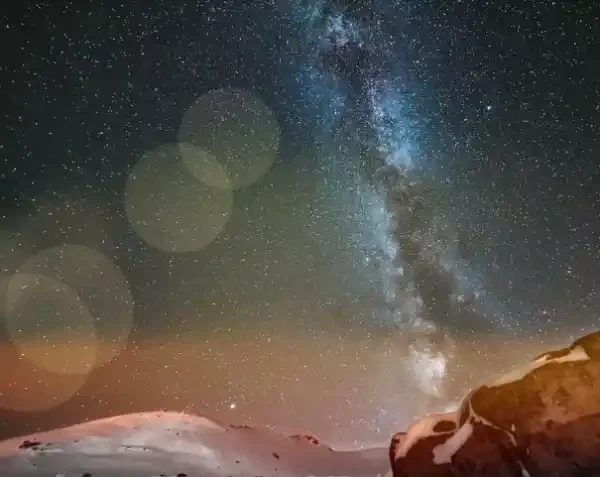
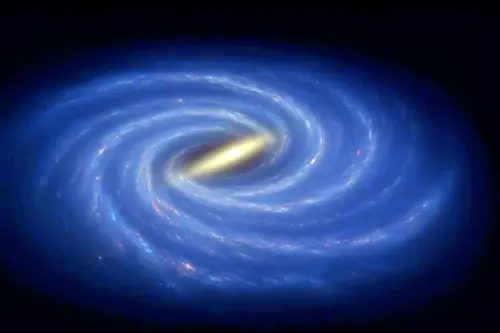
Galactic Mystery. From childhood lessons, we’re all familiar with the fact that our solar system our home planet, Earth, included resides within the sprawling celestial city known as the Milky Way Galaxy.
To call it vast is an understatement: our cosmic neighbourhood spans an incomprehensible 100,000 light-years in diameter. Within this magnificent structure, a dizzying count of approximately 400 billion stars twinkle, our well-known Sun being just one among them.
Yet, despite its familiarity in our night sky, a profound question often remains unanswered: What exactly occupies the very core of this immense galactic spiral?
The answer is one of the most exotic and mind-bending phenomena in the universe: a supermassive black hole named Sagittarius A* (often abbreviated as Sgr A* and pronounced “sadge-ay-star”).
This colossal object is the undisputed gravitational anchor of the Milky Way, the invisible nexus around which billions of stars, including our Sun, complete their millennia-long orbits.
It acts as the colossal, unseen heart that keeps the entire galaxy coherent, preventing its individual stellar and gaseous components from simply scattering into intergalactic space. Understanding Sgr A* is, in essence, understanding the fundamental structure and dynamics of our own galactic home.
Galactic Mystery, Genesis of a Black Hole Discovery.
The suspicion that something massive lurked at the Milky Way’s center began to coalesce long before the actual discovery of the black hole itself. Astronomers in the 1930s first detected strong radio wave emissions emanating from the direction of the constellation Sagittarius.
This signal, unlike the more uniform radiation from surrounding sources, was intense and compact, strongly suggesting a powerful, non-stellar source. However, pinpointing the exact location and true nature of this energy source remained a complex challenge.
The breakthrough arrived in 1974, when scientists Bruce Balick and Robert Brown, utilizing the National Radio Astronomy Observatory, precisely described this mysterious object and officially christened it Sagittarius A*.
This marked the beginning of a concerted scientific effort to peel back the layers of dust and gas that obscure the galactic center, a region that remains one of the most challenging observational targets in the sky.
For decades, the true identity of Sgr A* was a source of intense scientific debate. While some theorists strongly favoured the black hole hypothesis, others argued that the phenomenon could be explained by an incredibly dense, massive cluster of regular stars.
The critical evidence needed to settle the argument was difficult to obtain, as the object itself is invisible and hidden behind thick clouds of interstellar dust, requiring sophisticated observational techniques in the infrared and radio spectra.
Proving the Unseen.
The Nobel-Winning Evidence.
The definitive proof came in the 1990s through the groundbreaking, decades-long work of two independent research teams. One was led by German astrophysicist Reinhard Genzel, and the other by American astronomer Andrea Ghez. Their method was ingenious: since they couldn’t see the central object, they chose to observe the stars orbiting it.
Over many years, they meticulously tracked the orbits of stars closest to the galactic center, particularly a fast-moving star designated S2. Using advanced technologies, including adaptive optics to correct for the blurring effects of Earth’s atmosphere, they collected a powerful dataset detailing the precise paths of these ‘S-stars’.
The results were undeniable and dramatic: the stars were whipping around an invisible point at incredible speeds, following highly elliptical, Keplerian orbits.
By applying Newton’s laws of gravity and motion to these stellar orbits, Genzel and Ghez calculated the central object’s mass and volume. The conclusion was stunning: the ‘invisible attractor’ had a mass equivalent to approximately 4 million Suns, all contained within a volume no larger than our own Solar System (specifically, smaller than the orbit of Pluto).
No known configuration of stars, star clusters, or even exotic stellar remnants could account for such an immense mass packed into such a tiny space. The only entity that fit the data was a supermassive black hole. This landmark discovery finally confirmed Sgr A*’s true nature and earned both Reinhard Genzel and Andrea Ghez a share of the 2020 Nobel Prize in Physics.
Sizing Up the Beast.
The Dimensions of Sgr A*.
Today, the accepted mass of Sagittarius A* is approximately 4.3 million times the mass of our Sun. To put its size into perspective, its event horizon the boundary beyond which nothing, not even light, can escape has an estimated diameter of about 25 million kilometers (roughly 15.5 million miles). This makes it slightly larger than the orbit of the planet Mercury.
However, despite these colossal dimensions, the black hole poses absolutely zero threat to Earth. We are located in one of the galaxy’s spiral arms, a comfortable distance of roughly 26,000 light-years away from the core.
Its immense gravitational pull governs the galaxy’s overall rotation, but its influence on our solar system is negligible compared to that of the Sun and the local stellar environment. Our entire solar system orbits the center of the galaxy in a stately, 230-million-year-long ‘Galactic Year’.
Seeing the Invisible.
The First Portrait.
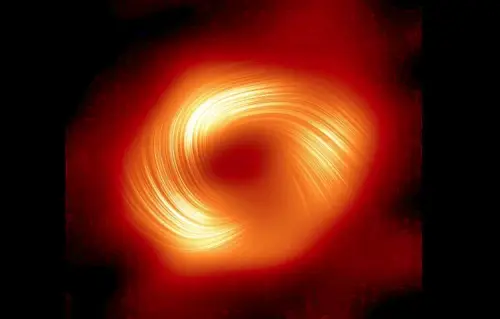
For the first time in history, the world was given a direct “look” at the black hole in May 2022. The Event Horizon Telescope (EHT) Collaboration a global array of synchronized radio dishes released the first-ever image of Sgr A*.
The image didn’t show the black hole itself (as it is, by definition, black), but rather its shadow cast against the brilliant backdrop of its own gravity-warped surroundings. The picture revealed a spectacular glowing ring of superheated gas swirling around a central dark region.
This bright ring is the light emitted by gas and plasma, accelerated to near light-speed, before it crosses the point of no return. The dark core is the shadow of the black hole, a visual confirmation of Einstein’s General Theory of Relativity in one of the universe’s most extreme environments.
This visual data, achieved through the remarkable feat of creating a virtual Earth-sized telescope, provided the final, stunning piece of evidence for the black hole at our galactic core.
A Quiet Giant.
The Enigma of Sgr A*.
Perhaps the most fascinating aspect of Sagittarius A* is its surprisingly dormant nature. While the supermassive black holes found in the centres of other galaxies, known as Active Galactic Nuclei (AGN) or quasars, are ravenous cosmic engines, constantly devouring vast amounts of matter and spewing out colossal jets of high-energy radiation, Sgr A* is remarkably placid.
It consumes material at an incredibly slow rate, and its radiation output is millions of times weaker than a typical active black hole. It’s often referred to as the ‘lazy’ or ‘sleepy’ black hole of the universe.
Current observations suggest that Sgr A* is only actively accreting (consuming) a small trickle of gas and plasma, primarily from the winds of a few massive, hot stars orbiting nearby. This low level of activity makes it safe to observe but challenging to fully understand.
Scientists hypothesize that the lack of readily available gas and dust in its immediate vicinity most of it having already been consumed or blown away is the main reason for its quiet state.
The core of the Milky Way, therefore, is a region of both immense power and profound mystery. It’s home to the most powerful gravitational entity in our galaxy, an object that simultaneously holds our entire cosmic structure together while defying our complete understanding.
The ongoing observations of Sagittarius A*, its surrounding stars, and its magnetic field structure continue to provide astronomers with a unique, close-up laboratory for testing the laws of physics under the most extreme conditions imaginable, promising a wealth of new discoveries about gravity, spacetime, and the life cycle of galaxies.
Have a Great Day!
