
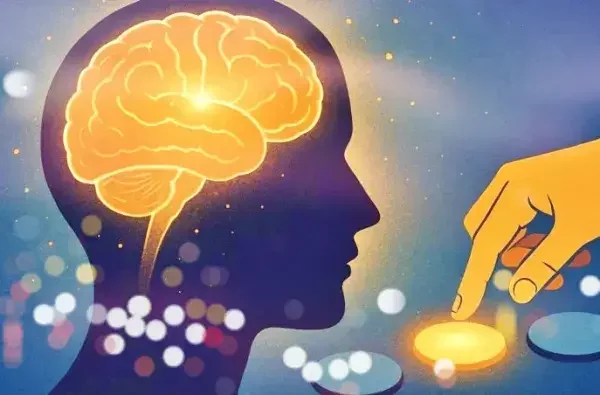
Decisions. We typically assume every decision we make is the product of careful thought, analysis, and, ultimately, our free will. The question “what should I choose?” feels like a deeply personal act, orchestrated by our conscious mind.
However, recent scientific discoveries are challenging this deeply ingrained belief. Scientists are increasingly finding evidence that decisions can originate in the brain long before a person becomes consciously aware of them.
This suggests that our brains might “know” what we’ll choose even before we feel like we’re making the choice ourselves. It implies that subconscious processes play a far greater role in decision-making than we’ve ever imagined.
But how does this impact our understanding of free will? And is it truly “I” who makes the decisions, or is it the brain, with consciousness merely acting as an observer?
Decisions, Your Brain Makes Decisions Before You Do.
A study from the Max Planck Institute caused a sensation when it revealed groundbreaking insights into decision-making.
Participants were asked to press one of two buttons whenever they felt the urge to do so, while researchers monitored their brain activity using fMRI. The astonishing finding was that brain regions associated with choice activated a full seven seconds before the conscious decision was made.
This means the brain “knew” the choice long before the individual consciously realized it.
This discovery significantly challenges the traditional notion of free will. If the brain makes a decision before we’re even aware of it, then perhaps our feeling of making a personal choice is simply a consequence of these hidden, pre-existing processes.
Some scientists now propose that consciousness isn’t the director of our actions but rather a commentator, narrating events that have already transpired.
Intuition.
Not Mysticism, But Rapid Calculation.
Many of us have experienced that uncanny feeling, as if an “inner voice” is guiding us on what to do. For a long time, intuition was considered an irrational, almost mystical sense.
However, neuroscientists now offer a compelling explanation: intuition is the result of accumulated experience and instantaneous analysis that occurs without the direct involvement of consciousness. Essentially, the brain rapidly compares the current situation with millions of patterns already stored in memory.
At its core, intuition is the brain’s ability to make lightning-fast predictions based on subconscious computations. This phenomenon is particularly evident in highly experienced professionals: chess grandmasters “see” the best move, doctors “sense” a diagnosis, and drivers make instantaneous decisions in emergency situations.
These aren’t mystical occurrences; they are the product of incredibly rapid neural network activity.

The Delay Between Decision and Awareness.
In the 1980s, neurologist Benjamin Libet was the first to document that the brain begins preparing for movement approximately 0.3 seconds before a person consciously desires to perform that action.
This was a pivotal step toward understanding that the brain can act “autonomously.” Consciousness, it seems, plays catch-up with events rather than initiating them.
Further experiments have consistently confirmed this: by the time we experience a conscious choice, a chain of processes has already unfolded within the brain.
This suggests that we only feel like we are making decisions ourselves, when in reality, our subconscious is doing it for us. The critical question then becomes: can we, at the last moment, override an “automatic” decision?
Benjamin Libet referred to this as the “veto power” the last bastion of free will. However, even this hypothesis remains unproven and highly debated.
It’s not impossible that our actions are entirely predetermined, and free will, as we understand it, doesn’t exist at all. Yet, even this perspective doesn’t diminish human individuality.
Instead, it highlights the profound importance of the invisible mechanisms that influence our behavior. This knowledge can be incredibly helpful for instance, in combating impulsive decisions.
By understanding how these processes work, we can potentially train ourselves to exert more control over them.

The Autonomous Supercomputer Within.
Increasingly, science is concluding that our brain is not merely an organ of conscious thought, but also an autonomous supercomputer that makes decisions even before we become aware of them. This doesn’t necessarily mean we lack free will entirely.
Rather, it suggests that free will might operate differently than we’ve traditionally assumed. Consciousness, in this view, is merely the tip of the iceberg, beneath which lie entire layers of rapid, automatic information processing.
Understanding these intricate mechanisms provides us with powerful tools for living a more conscious life. We can learn to recognize the brain’s subtle cues, thoughtfully consider our impulses, and ultimately adjust our behavior. For even if the initial impulse arises unconsciously, it is still up to us how we ultimately choose to act.
Have a Great Day!
